


Page 21 - 新思维科学教师用书5 试读样张
P. 21
1 Life CyCLes of fLoWering pLants
CONTINUED
Guide learners towards appropriate explanations question before discussing it. Ask everyone to
in these ways: write down an answer and choose a few answers
• Ask the original question in a different way. to read out. You could also give learners a choice
• Ask the learner for clarification, e.g. ‘What do of possible answers to discuss and vote on the
correct option. For example, if you ask why plants
you mean when you say...?’ have flowers give these options: because flowers
• Ask for specific examples. look nice to us; because flowers make food for
• Ask the learner to explain again in a different bees and other insects; because flowers help the
way. plant reproduce.
To be more inclusive in your questioning, rather The way you give feedback to learners’ answers
than asking for ‘hands up’, move around the is also important. In general, do not make
classroom and ask learners at random to answer comments on how good or otherwise an answer
the question. You could also include more learners is. Rather, thank the learner for the answer and say
by allowing them to talk to each other about something such as, ‘Let’s think a bit more about
a question. The ‘think-pair-share’ strategy can what X has said’. Then discuss the answer with the
be useful to make sure learners think about the class. Or ask, ‘What other ideas do people have?’
and allow another learner to give their answer.
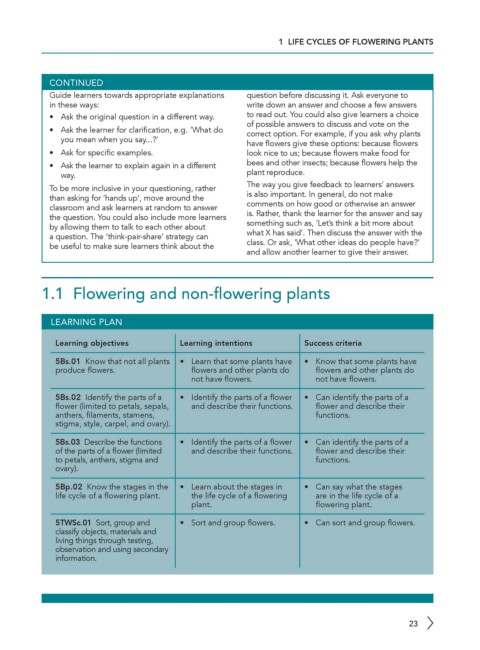
1.1 Flowering and non-flowering plants
LEARNING PLAN
Learning objectives Learning intentions success criteria
5Bs.01 Know that not all plants • Learn that some plants have • Know that some plants have
produce flowers. flowers and other plants do flowers and other plants do
not have flowers. not have flowers.
5Bs.02 Identify the parts of a • Identify the parts of a flower • Can identify the parts of a
flower (limited to petals, sepals, and describe their functions. flower and describe their
anthers, filaments, stamens, functions.
stigma, style, carpel, and ovary).
5Bs.03 Describe the functions • Identify the parts of a flower • Can identify the parts of a
of the parts of a flower (limited and describe their functions. flower and describe their
to petals, anthers, stigma and functions.
ovary).
5Bp.02 Know the stages in the • Learn about the stages in • Can say what the stages
life cycle of a flowering plant. the life cycle of a flowering are in the life cycle of a
plant. flowering plant.
5tWsc.01 Sort, group and • Sort and group flowers. • Can sort and group flowers.
classify objects, materials and
living things through testing,
observation and using secondary
information.
23
ࠡ JOEC
ࠡ JOEC

