


Page 38 - 新思维数学教师用书3 试读样张
P. 38
MATHEMATICS 3 TEACHER’S RESOURCE
1.3 Estimating and rounding
LEARNING PLAN
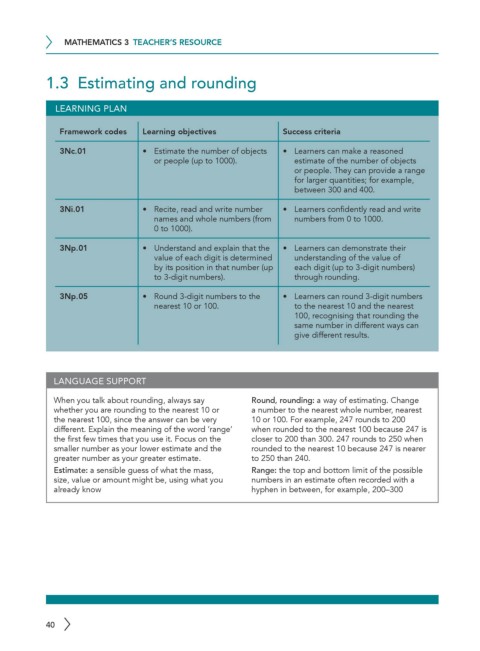
Framework codes Learning objectives Success criteria
3Nc.01 • Estimate the number of objects • Learners can make a reasoned
or people (up to 1000). estimate of the number of objects
or people. They can provide a range
for larger quantities; for example,
between 300 and 400.
3Ni.01 • Recite, read and write number • Learners confidently read and write
names and whole numbers (from numbers from 0 to 1000.
0 to 1000).
3Np.01 • Understand and explain that the • Learners can demonstrate their
value of each digit is determined understanding of the value of
by its position in that number (up each digit (up to 3-digit numbers)
to 3-digit numbers). through rounding.
3Np.05 • Round 3-digit numbers to the • Learners can round 3-digit numbers
nearest 10 or 100. to the nearest 10 and the nearest
100, recognising that rounding the
same number in different ways can
give different results.
LANGUAGE SUPPORT
When you talk about rounding, always say Round, rounding: a way of estimating. Change
whether you are rounding to the nearest 10 or a number to the nearest whole number, nearest
the nearest 100, since the answer can be very 10 or 100. For example, 247 rounds to 200
different. Explain the meaning of the word ‘range’ when rounded to the nearest 100 because 247 is
the first few times that you use it. Focus on the closer to 200 than 300. 247 rounds to 250 when
smaller number as your lower estimate and the rounded to the nearest 10 because 247 is nearer
greater number as your greater estimate. to 250 than 240.
Estimate: a sensible guess of what the mass, Range: the top and bottom limit of the possible
size, value or amount might be, using what you numbers in an estimate often recorded with a
already know hyphen in between, for example, 200–300
40
4+ ྍනົඔ࿐࢝ഽႨ ᆞ໓č1 Ď @නૼ JOEE
4+ ྍනົඔ࿐࢝ഽႨ ᆞ໓č1 Ď @නૼ JOEE

